

Food Safety Guide
Handling Food
Storage Temperature & Conditions
Appropriate temperature is especially pertinent to Categories 3 and 4 – potentially hazardous foods. These foods are at risk for temperature abuse if they are not kept at their proper storage temperatures. Foods that require refrigeration should be kept between 0°C to 4°C and frozen foods at –18°C or less. Category 1 Non-Perishable Foods are shelf stable and can be just kept at room temperature.
Personnel & Hygiene
Any person (e.g. volunteer, employees, transportation personnel) prior to entering food handling areas, is required to properly wash their hands and immediately after contacting contaminated materials. Frequent hand washing is encouraged and volunteers or transportation personnel should wash their hands again:
- After eating, smoking, or using the washroom
- Handling of any raw meat, poultry, or seafood
A person should not be handling food in the following health conditions:
- Have experienced diarrhea or vomiting within the last 72 hours
- Experiencing persistent coughing, sneezing, fever, sore throat
- Suffering from contagious diseases or infections (e.g. Hepatitis A, influenza)
- Have an open cut or wound (must be covered with a waterproof bandage if handling food)
Gloves should be worn when there needs to be direct contact with foods.
Food Safety & Training
Important decisions are made when someone is handling food and proper training are needed for those involved in main aspects of donating the food such as operating, handling, and distributing of foods.
FOODSAFE is a course recommended for handlers of food. The Food Premises Regulation instructs every operator of a food service establishment to hold a FOODSAFE certificate or its equivalence. Volunteers, operating employees, and handlers of the food are encouraged to complete at minimum the FOODSAFE Level 1 Program or equivalent. This certificate is valid for five years after the training is successfully completed.
For details, see the FOODSAFE website.
Unaccepted Food
Table 1. Unaccepted Products
| Recalled Products | Please follow your in-store food recovery donation guidelines or contact FoodMesh. For current recalls, please visit the CIFA. |
| Unlabeled Products |
|
| Unpasteurized Products |
|
| Damaged Goods |
|
| Visible mould, significantly bruised, rotten or has an off odour | Although some solid foods with mould can be salvaged, they are not permitted for donation due to sensitivity with handling and contamination. Bruising in a large area (mainly produce) degrades quickly and is not ideal for donations. |
| Mishandled or unsafe foods |
|
| Open buffet food | Food where people served themselves |
*See appendix for reference.
Evaluate the Safety of Your Product
If your product doesn’t belong to the unacceptable products listed above, that’s great! Now let’s evaluate the condition of the food to ensure it is definitely safe to be donated. If your business has a Quality Assurance team, they need to give the go-ahead on food safety before donations can be posted to Mesh. Any product that wouldn’t be safe for consumers should not be donated.
Danger Zone
The danger zone is the range between 4°C and 60°C where most bacteria multiply the fastest. The time that foods are kept in this temperature range should be avoided or kept as short as possible. Category 3 and 4 Foods (Table 2) should be kept at their proper storage temperature.
Vancouver Coastal Health’s Guide to Washing Hands
Hands should be washed:
- Before handling foods/after handling raw foods
- After using the toilet
- After smoking/using a toothpick
- After touching face, hair etc.
- After covering a cough or sneeze
- Any time hands may be contaminated
Proper hand washing steps:
- Wet hands
- Apply liquid soap from a pump dispenser
- Rub hands together
- Dry hands with a paper towel
- Turn off the tap with a paper towel
Food Categories & Risk
Table 2. Food Categories & Risk
| Category | Examples |
| 1 – Non-Perishable Foods |
|
| 2 – Low-Risk Perishable Foods |
|
| 3 – Potentially Hazardous Foods |
|
| 4 – Prepared Foods |
|
Safety Evaluation
The following flow charts from the BC Centre for Disease Control’s: Guidelines for Food Distribution Organizations with Grocery or Meal Programs ,are intended to help determine the safety of the perishable food product. If after using the flow charts, you’re uncertain about the fit for donation, contact us to help figure this out.
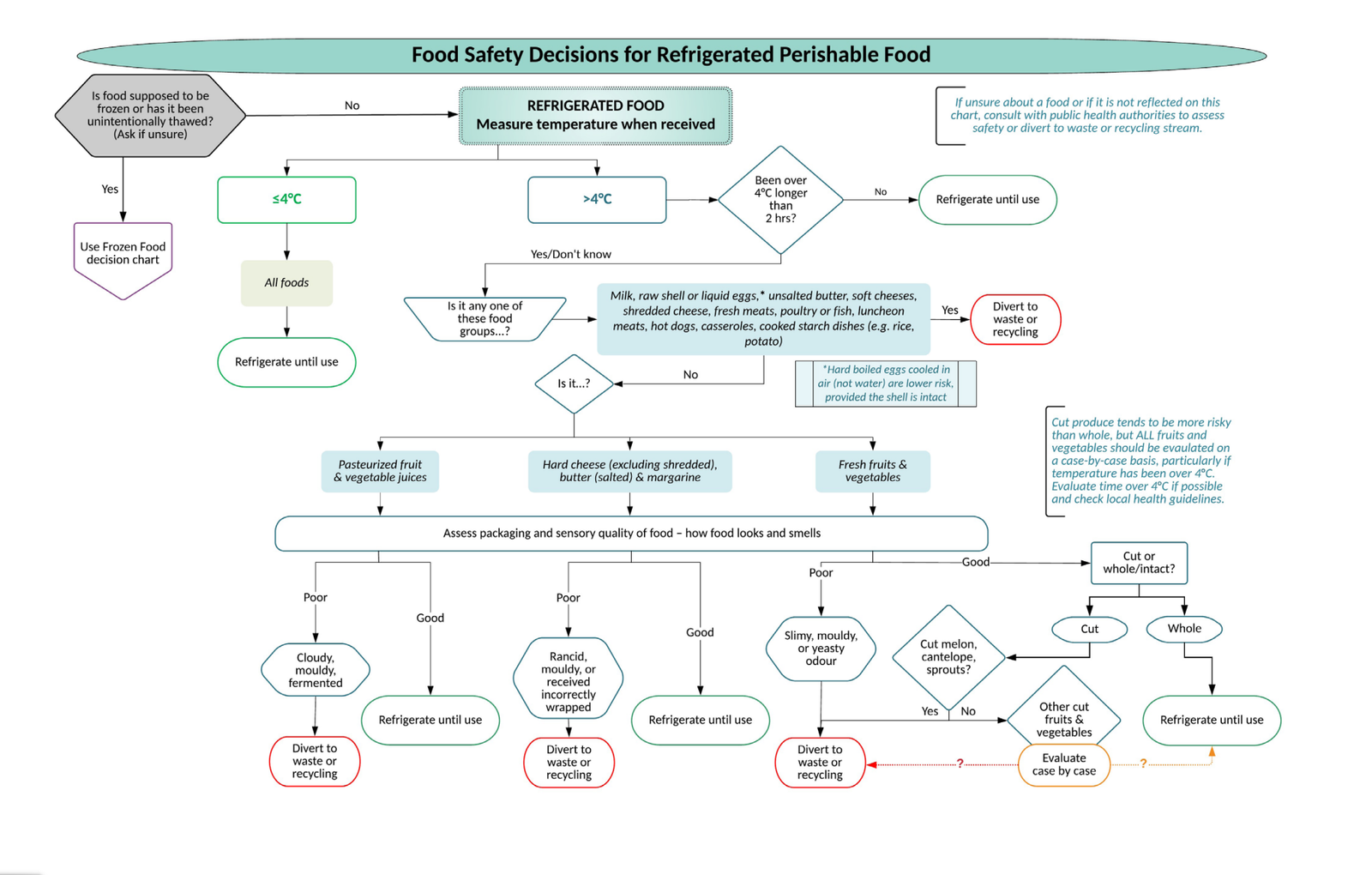
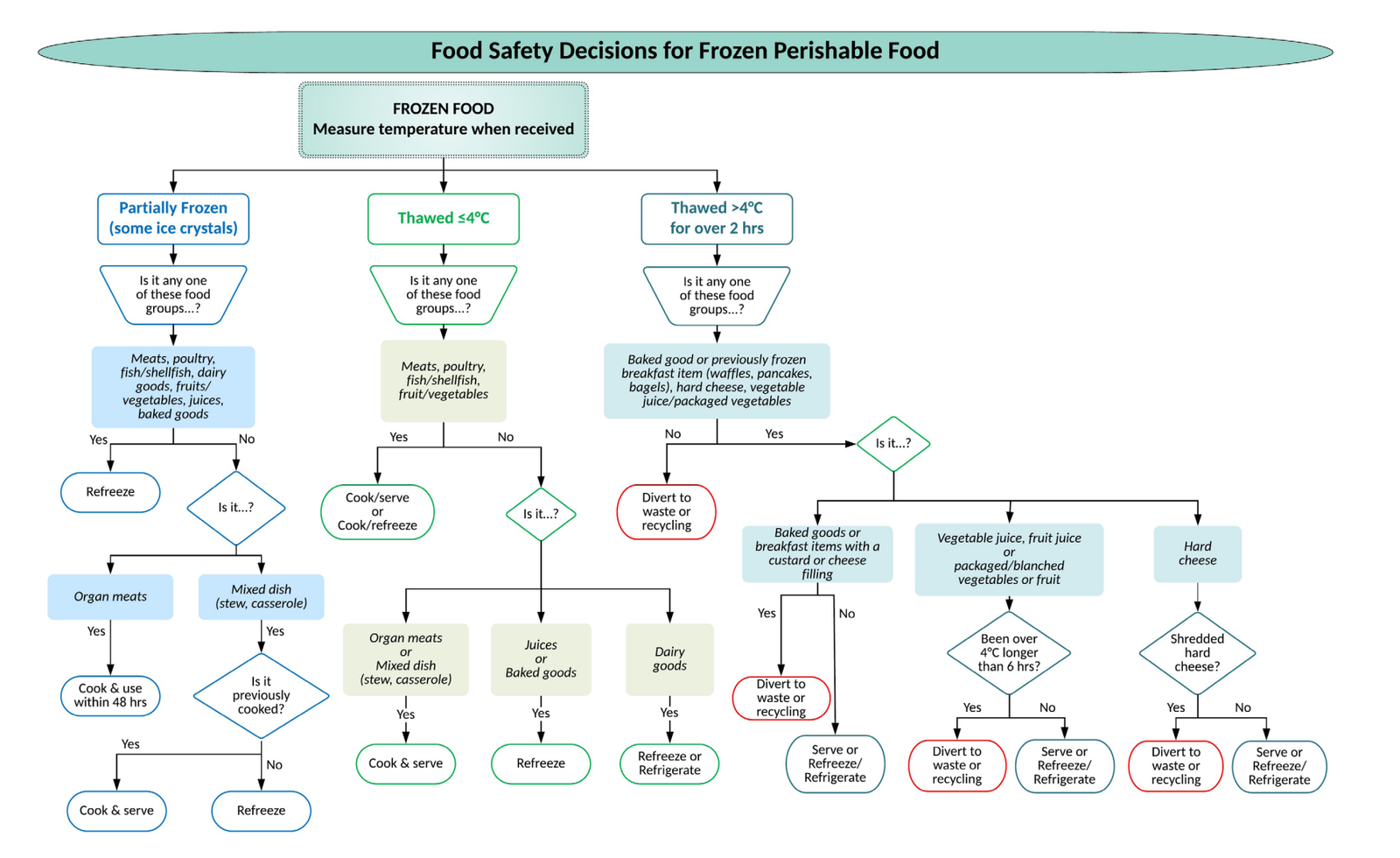
Best before date or sell-by date is more of an indicator of quality than safety. Food generally declines in quality before there is an increased risk to food safety. Often freezing products can significantly prolong the life of the product.
As an overall rule, foods should be kept at their proper storage temperatures and not be removed until it is ready for donation.
Table 3. Maximum accepted storage time of products frozen before expiration
Traceability & Transportation
Traceability
Record keeping is important in keeping track of products. In case of a recall, the donor is able identify whether the donated products have been affected. Information pertinent to the product for donation should include the following:
- Name of Product
- Date of Harvest/Manufacturing
- Lot Number/Production Code
- Quantity Produced
- Best Before Date/Expiry Date/Sell By Date
- Required Storage Temperature
- Ingredient List & potential allergen – if applicable
10 identified major allergens in Canada:
- Eggs
- Milk
- Mustard
- Peanuts
- Seafood (fish, shellfish)
- Sesame
- Soy
- Sulphites
- Tree Nuts (including coconut)
- Wheat
Transportation
Food recipients may have the capacity to pick up while others may need the food delivered. This would be coordinated on FoodMesh. Perishable foods should be kept in appropriate temperatures during transportation through mechanical refrigeration or chilled chest coolers.
- Always use a clean and sanitary transport vehicle
- Food should not be directly in contact with the ground (i.e. where persons may be walking) and need to be in transported in safe, non-absorbent, leak-proof containers.
- If temperature-controlled transportation is not available, foods should be labeled “processed immediately” for donation.
Category 3 – Potentially hazardous foods should not be out of proper storage temperature more longer than 2 hours (including transportation, storage, cooling).
Related Resources
- BC Centre for Disease Control’s:Guidelines for Food Distribution Organizations with Grocery or Meal Programs
Page last updated: August 2022